Chesapeake Watershed Restoration Academy
Building a Green Career Pathway in South Baltimore
- Client
- South Baltimore Gateway Partnership
- Partners
- Grow Home
Maryland Climate Crew Network - Focus
- Workforce Development · Environmental Restoration · Program Design · Partnership Development · Implementation & Evaluation
The Challenge
South Baltimore is experiencing significant investment in environmental restoration and green infrastructure through projects associated with the Reimagine Middle Branch initiative. That investment presented a larger opportunity: could the restoration of the landscape also create meaningful career pathways for people living in the surrounding communities?
South Baltimore Gateway Partnership engaged Bluebird Enterprises to help develop the Chesapeake Watershed Restoration Academy, an initiative designed to connect residents—particularly people facing barriers to employment—with emerging careers in ecological restoration, urban forestry, green infrastructure, and related industries.
The original concept envisioned a native plant nursery that could simultaneously serve as a training enterprise and supply restoration projects. Bluebird's feasibility work, however, revealed significant challenges related to startup costs, operations, plant requirements, market competition, and scalability.
Rather than force the original concept forward, we helped redesign it.
Our Approach
Bluebird led a research and program-development process that combined financial and operational feasibility analysis, stakeholder engagement, workforce research, employer interviews, and direct examination of successful green workforce models.
The work included engagement with restoration contractors, workforce organizations, community partners, public agencies, and training providers, as well as an immersive site visit with PowerCorps Philadelphia.
A consistent finding emerged: employers could teach many technical skills. Their greater challenge was finding entry-level employees who were reliable, prepared for the workplace, supported through barriers that could disrupt employment, and connected to a clear pathway into the industry.
That insight fundamentally shaped the program.
Bluebird recommended moving away from the nursery-centered model and toward a paid, hands-on career pathway built around foundational green skills, real restoration work, individualized support, employer exposure, and increasingly direct connections to employment.
From Program to Ecosystem
The resulting model brings together organizations with distinct but complementary roles.
Grow Home provides the community-based foundation: recruitment, paid field experience, workforce readiness, case management, mentorship, and hands-on training.
The Maryland Climate Crew Network connects the program to the larger green workforce ecosystem through specialized training, employer relationships, career exposure, and apprenticeship development.
South Baltimore Gateway Partnership provides investment, community connections, restoration opportunities, and strategic alignment with the broader transformation underway in South Baltimore.
Bluebird provides the connective infrastructure—program strategy, implementation oversight, partner coordination, performance management, problem-solving, and continuous refinement.
Together, the partners created a pathway in which participants do more than learn about environmental work. They work on real landscapes, meet the businesses and professionals doing the work, develop technical and professional skills, and begin to see themselves as part of the industry.
Learning by Doing
The pilot was deliberately designed around paid, hands-on experience.
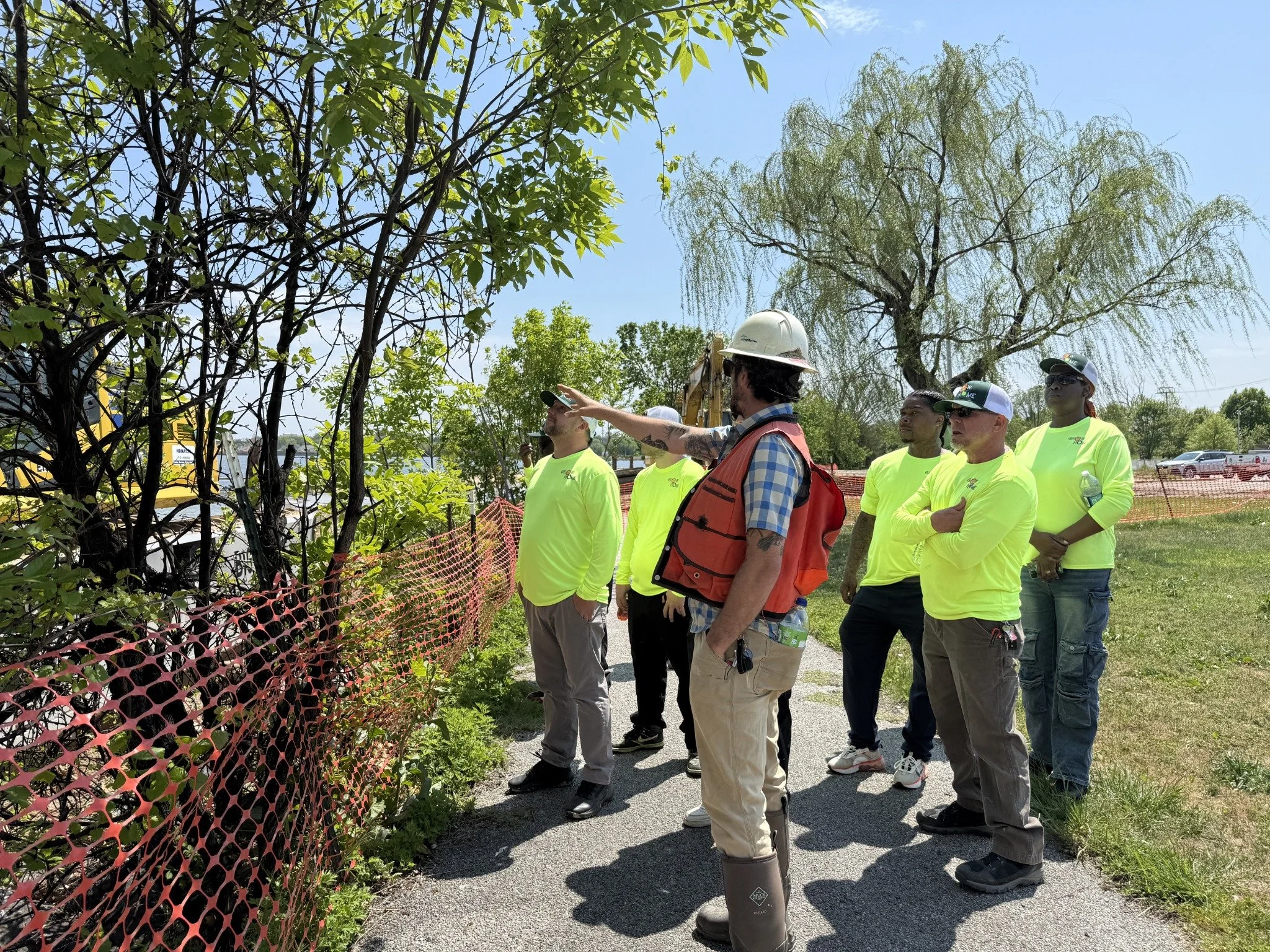
Participants work alongside experienced field instructors on projects involving tree planting and maintenance, native landscapes, invasive species management, stormwater practices, and environmental restoration. Classroom and field instruction are reinforced through certifications, career readiness training, case management, and direct exposure to employers.
Employer engagement became an especially important component of the model. Rather than waiting until graduation to introduce participants to potential employers, the program increasingly brings businesses into the learning process through site visits, career exposure days, curriculum feedback, hands-on projects, internships, apprenticeships, and hiring conversations.
This creates a two-way relationship: participants gain a clearer view of possible careers, while employers help define what workforce readiness actually looks like.
Adapting the Pilot in Real Time
Because this was a pilot, Bluebird treated implementation itself as a source of information.
When early experience revealed opportunities to strengthen recruitment, training consistency, case-management integration, and employer engagement, Bluebird facilitated an operational reset with program partners. The team established a clearer community referral funnel, a more consistent training cadence, stronger integration between case management and instruction, and a more intentional employer-engagement strategy.
That process reflected a central principle of our work: successful program design does not end when implementation begins. We establish systems that allow partners to observe what is happening, learn from participants and employers, measure results, and adapt.
The Broader Impact
The Restoration Academy sits at the intersection of workforce development, environmental restoration, community investment, and economic mobility.
Its value is not simply that residents are trained for green jobs.
Participants develop workplace skills and technical knowledge while improving landscapes in and around their own communities. Restoration businesses gain exposure to a new pipeline of potential employees. Community organizations become part of the recruitment and stewardship network. And public investment in environmental infrastructure begins generating human capital alongside physical improvements.
The people learning how to restore a watershed are also becoming its future workforce—and, in the process, its stewards.
What Bluebird Brought to the Work
Bluebird's role has extended from concept development through implementation: testing the original business model; conducting feasibility and industry research; engaging employers and community stakeholders; redesigning the program around evidence; structuring partnerships; developing performance measures; coordinating implementation; identifying operational challenges; and helping the partners continually improve the model.
The result is more than a training program.
It is an emerging career pathway infrastructure designed to connect community talent, environmental investment, employers, and place—and to demonstrate how restoration of a landscape can also create opportunity for the people who call that landscape home.